How to Improve Your Meta Ads: A Practical Guide to Better Targeting, Lower Costs, and Higher ROAS
Meta ads rarely underperform because the platform's broken it's fixable mistakes: wrong objective, fuzzy targeting, weak creative, or killing campaigns too early. Here's how to fix each, in the order that moves performance.
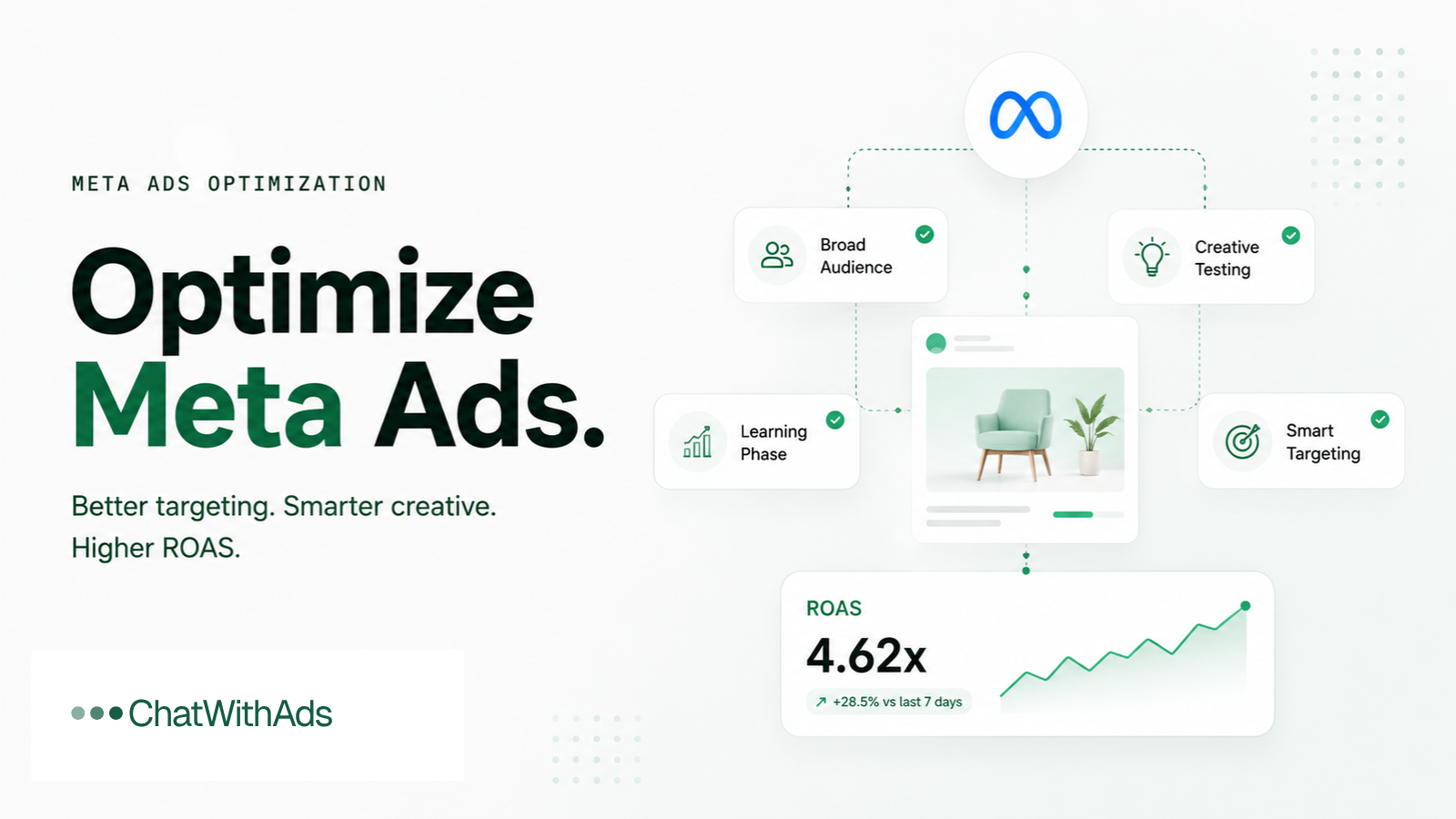
If your meta ads feel like they're quietly draining your budget, you're not alone. Most accounts don't underperform because the platform is broken; they underperform because of small, fixable mistakes compounding over weeks: weak creative, fuzzy targeting, the wrong objective, or campaigns that are never given enough data to learn. The good news is that almost every one of these issues is within your control.
This guide walks through the levers that actually move performance, in the order you should pull them. Whether you're spending your first $500 or scaling past six figures a month, the way you meta advertise rewards the same fundamentals. Let's get into it.
Start With the Right Campaign Objective
Before you touch a headline or an image, you choose an objective and that single decision shapes everything the algorithm does next. The objective tells the system which people to find and what action to optimize for. Pick the wrong one and even brilliant creative people will struggle.
A common, expensive error is optimizing for traffic or engagement when you actually want sales. Those objectives are cheaper per click, which feels good in the dashboard, but they send your spend toward people who like to click, not people who like to buy. If revenue is the goal, optimize for purchases or conversions and let the system learn from real buying behavior.
Quick rule of thumb: Match the objective to the business outcome, not the vanity metric. Sales campaigns optimize for purchases. Lead-gen campaigns optimize for leads. Awareness campaigns optimize for reach. Never mix the two hoping for the best.
Tighten Your Targeting Then Loosen It
Targeting is where beginners overthink and experts simplify. Years ago, stacking dozens of narrow interests was the move. Today the system is far better at finding the right audience on its own, provided you feed it a clear signal and enough budget to learn.
Let broad targeting do the heavy lifting. For most conversion campaigns, a broad audience with a strong conversion event outperforms a heavily layered one. Give the algorithm room to explore, and it will surface buyers you'd never have hand-picked. Start broad, watch the data, and only narrow if performance demands it.
Use your own data as the foundation. Your highest-intent audiences are people who already know you:
- Website visitors - retarget people who browsed but didn't convert.
- Customer lists - upload past buyers to create lookalikes of your best customers.
- Engagers - reach people who watched your videos or interacted with your profile.
Lookalike audiences built from actual purchasers are consistently among the most profitable targeting options available, because they're modeled on people who have already proven they'll pay.
Make Creative Your Real Competitive Edge
Here's the truth most dashboards won't tell you: in a mature ad account, creativity is the single biggest driver of performance. Targeting and bidding are largely automated now. Your creative hook, the visual, the message is what you still fully own, and it's where the biggest wins hide.
Stop the scroll in the first second. People decide whether to keep watching almost instantly. Lead with motion, a bold statement, a surprising visual, or a problem your audience feels immediately. Save the logo reveal and slow build-up for somewhere else by then most viewers are gone.
Test angles, not just colors. Swapping a button color rarely changes much. Testing entirely different messages does. If you're deciding what are the three types of ads worth prioritizing, think in terms of formats image, video, and carousel then vary the message inside each:
- A problem-agitation angle that names the pain point head-on.
- A social-proof angle built around testimonials or results.
- A benefit-led angle focused on the outcome the customer wants.
- An offer-led angle that leads with a discount, bundle, or guarantee.
Let real spend decide the winner, then double down on the angle that works and spin new variations from it.
Respect the Learning Phase
Every campaign goes through a learning phase while the system figures out who responds. During this window performance is volatile and costs are unreliable. The most common mistake is panicking, pausing, editing, or killing campaigns before they've escaped learning. Each significant edit can reset the clock.
Give it room to learn: As a general guide, a conversion ad set needs roughly 50 conversions per week to exit the learning phase and stabilize. If your budget can't realistically generate that, consolidate ad sets or choose a cheaper conversion event higher in the funnel.
Patience here isn't passive. It's the discipline to let the data accumulate before you judge a campaign and it separates accounts that scale from accounts that churn.
Read the Metrics That Actually Matter
It's easy to drown in numbers inside the meta ads manager. Focus on the few that connect spend to revenue, and use the rest only to diagnose problems:
- ROAS - revenue earned for every dollar spent; your north-star profitability metric. Watch it for scaling decisions.
- CPA - what it costs to acquire one customer or lead. Watch it for budget efficiency.
- CTR - how compelling your creative and hook are. Watch it for creative health.
- CPM - cost to reach 1,000 people; a signal of audience competition. Watch it for auction pressure.
- Frequency - how often the same person sees your ad before fatigue sets in. Watch it for a creative refresh.
If your ROAS is healthy, resist the urge to fiddle. If your CTR is low, fix the creative. If frequency is climbing and results are sliding, your audience has seen the ad too many times refresh it. Diagnose, then act on one variable at a time.
Move Faster With ChatWithAds
Doing all of the above well takes time most teams don't have pulling reports, spotting fatigue, rewriting copy, deciding what to scale. This is exactly where ChatWithAds earns its place in your workflow. Instead of digging through tabs and spreadsheets, you simply chat with your ad data in plain language and get clear, decision-ready answers.
Rather than replacing your judgment, it removes the busywork around it. A few ways teams put it to work:
- Ask plain-English questions like "which campaigns dropped in ROAS this week?" and get an instant, sourced answer.
- Spot fatigue early with proactive alerts when frequency climbs or CTR slips, so you refresh before performance tanks.
- Generate creative angles and fresh ad copy variations to test, in seconds, based on what's already working in your account.
- Get scaling recommendations that flag which ad sets are ready for more budget and which are quietly bleeding spend.
Put your reporting on autopilot: ChatWithAds turns hours of manual analysis into a quick conversation so you spend less time auditing dashboards and more time on the creative and strategy that actually grows revenue.
Build a Simple, Repeatable Optimization Routine
Great accounts aren't lucky they're systematic. Improvement compounds when you review on a rhythm instead of reacting emotionally to daily swings:
- Daily (5 minutes): a quick glance for anything broken spend spikes, disapprovals, or a campaign that died overnight. If you're just starting out and wondering what's a good daily budget for Facebook ads, a small, steady amount you can sustain long enough to clear the learning phase beats a big spend you'll panic-pause.
- Weekly (30 minutes): review ROAS, CPA, and frequency; pause clear losers, and queue new creative to test.
- Monthly (1 hour): zoom out to trends, reallocate budget toward winning angles, and plan the next batch of experiments.
This is also where a tool like ChatWithAds compresses the work of what used to be a half-day audit becomes a short check-in, freeing you to focus on the levers that matter most.
The Bottom Line
Improving your results is less about chasing secret hacks and more about doing the fundamentals consistently: choose the right objective, trust broad targeting backed by your own data, treat creativity as your edge, respect the learning phase, and act only on the metrics that tie back to revenue. Layer a simple review routine on top, and you've built a system that improves week over week.
Pull these levers in order, give each change time to prove itself, and lean on tools like ChatWithAds to handle the heavy lifting of analysis. Do that, and your next campaign won't just spend your budget it'll grow your business.
Get the next one in your inbox
Marketing-analytics deep dives like this one, straight to your inbox. No spam, unsubscribe anytime.