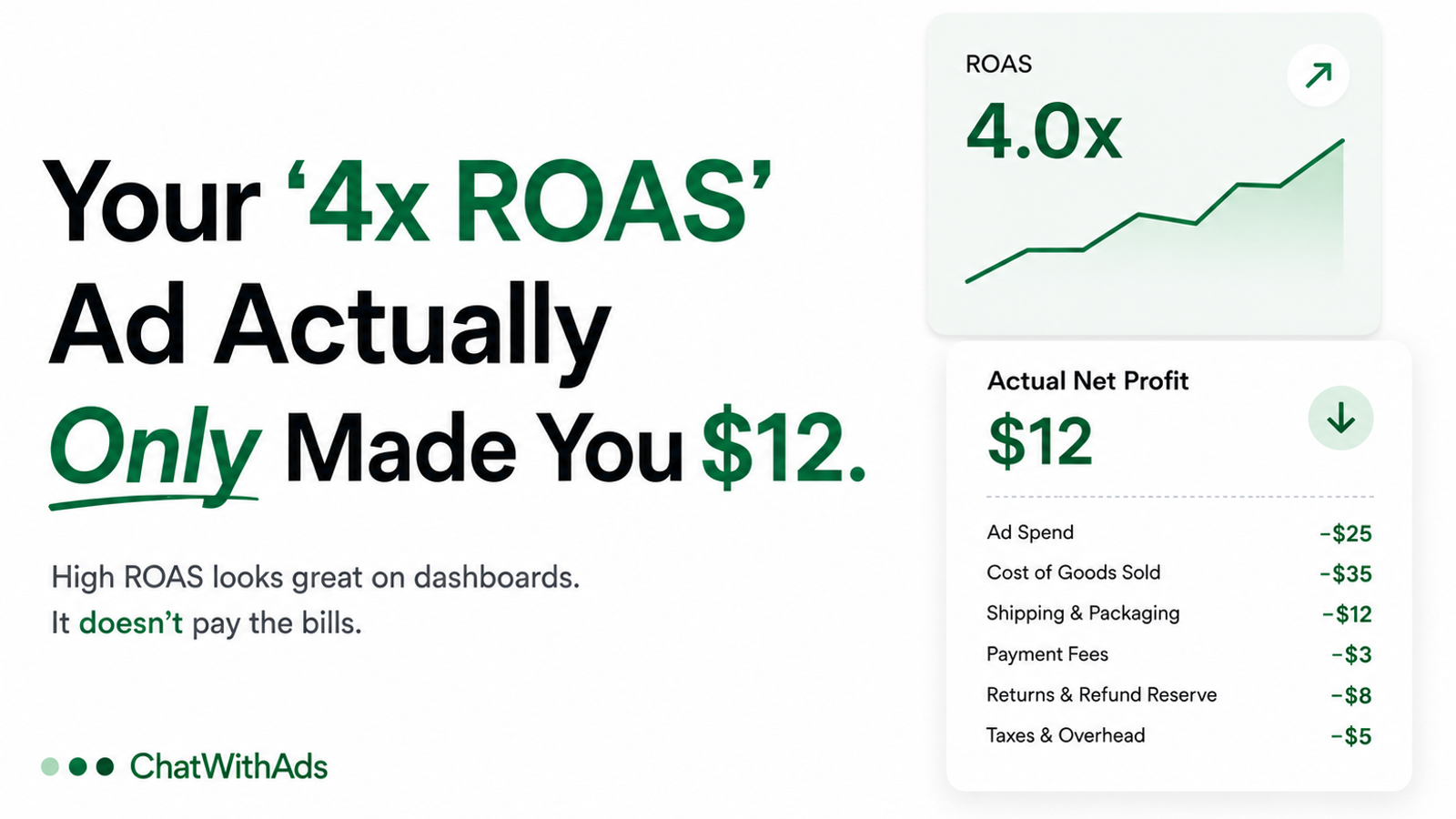
Your "4x ROAS" Ad Actually Only Made You $12.
A 4x ROAS can still lose you money. Learn why revenue isn't the same as profit, uncover the hidden costs behind every sale, and discover how to identify truly profitable ad campaigns instead of relying on vanity metrics.
If you run an e-commerce brand, you've been taught a lie.
The lie is that Return on Ad Spend (ROAS) is the metric that matters most.
It isn't.
You cannot pay your rent, your staff, or your inventory bills by prioritizing vanity metrics over true profitability. You can only pay them with cold, hard cash.
If you're looking at a green dashboard while wondering, "Why am I losing money despite high ROAS?", here's exactly how a "successful" ad can quietly destroy your business — and how to stop the bleeding in less than two minutes.
The Trap: The Math Meta Doesn't See
Let's say you sell a premium leather wallet.
- Selling Price: $100
- Your ROAS: 4x
That means you spent $25 on Meta Ads to generate $100 in revenue.
On paper, it looks like you made $75.
Awesome, right?
Wrong.
A standard marketing dashboard is built to track clicks, conversions, and revenue. It doesn't automatically factor in the costs that determine whether your business actually makes money.
Let's add those back in.
Revenue / Cost | Amount |
|---|---|
Revenue | $100 |
Meta Ads Spend | -$25 |
Cost of Goods Sold | -$35 |
Shipping & Packaging | -$12 |
Payment Processing Fees | -$3 |
Returns & Refund Reserve | -$8 |
Estimated Taxes & Business Overhead | -$5 |
Actual Net Profit | $12 |
Your 4x ROAS ad actually only made you $12.
Now imagine:
- Your supplier increases shipping costs by $5 tomorrow.
- Meta's advertising costs rise by 20%.
Either way, your $12 profit shrinks dramatically.
Yet your dashboard can still happily display a 4x ROAS.
You'll keep increasing budgets while wondering why your bank account keeps shrinking.
How to Find the "Bleeding" Ads Right Now
Stop looking only at your Meta Ads dashboard.
Grab a piece of paper and write this down for your best-selling product. Start with your selling price, then subtract:
- Cost of Goods Sold
- Shipping
- Payment Processing Fees
- Returns & Refund Reserve
- Taxes
- Business Overhead
Suppose your product leaves $37 after every operational cost.
You cannot sustainably spend more than $37 to acquire a customer.
If your Meta Ads dashboard reports a CPA of $45, that campaign is losing money even if it reports an impressive ROAS.
There is no universal "good" ROAS.
It doesn't matter how high the ROAS looks.
It is losing you money.
Why Waste Time With Spreadsheets?
You shouldn't have to spend your Sunday nights typing numbers into messy spreadsheets just to find out whether your business actually made money.
Traditional business intelligence software forces teams to stitch together reports from advertising platforms, commerce systems, payment processors, and finance tools before they can answer one simple question:
"Which campaigns are actually making me money?"
You don't need another dashboard.
You don't need another graph.
You need an AI-powered marketing co-pilot that transforms raw metrics into clear, actionable business insights.
Meet ChatWithAds
That's why we built ChatWithAds.
An autonomous AI agent for paid media teams that connects directly to your platforms and lets you ask questions in plain English.
Instead of digging through dashboards, simply ask:
- Which Meta Ads campaigns are actually profitable?
- Why did my CPA increase this week?
- Which products generate the highest profit margin?
- Where am I wasting ad spend?
- What should I scale next?
The platform doesn't just tell you what happened.
It explains why it happened and what to do next.
Profit Is the Metric That Deserves Your Attention
ROAS remains an important advertising metric.
It should never be ignored.
But it should never be viewed in isolation.
Healthy businesses are built by maximizing profitable customer acquisition, not simply maximizing revenue.
Before increasing your Meta Ads budget, ask yourself one question:
"Is this campaign generating profit, or only revenue?"
That single question can fundamentally change how you evaluate marketing performance.
If you're ready to understand which campaigns actually generate profit, not just revenue, ChatWithAds can help.
Book a Free 15-Minute Walkthrough
Give us 15 minutes, and we'll show you what was missing.
Book a direct 15-minute session.
Get the next one in your inbox
Marketing-analytics deep dives like this one, straight to your inbox. No spam, unsubscribe anytime.