Your Monday Performance Review Should Take 10 Minutes, Not 3 Hours
Stop spending 3 hours assembling reports—your Monday performance review should take 10 minutes and end with a decision, not a spreadsheet.
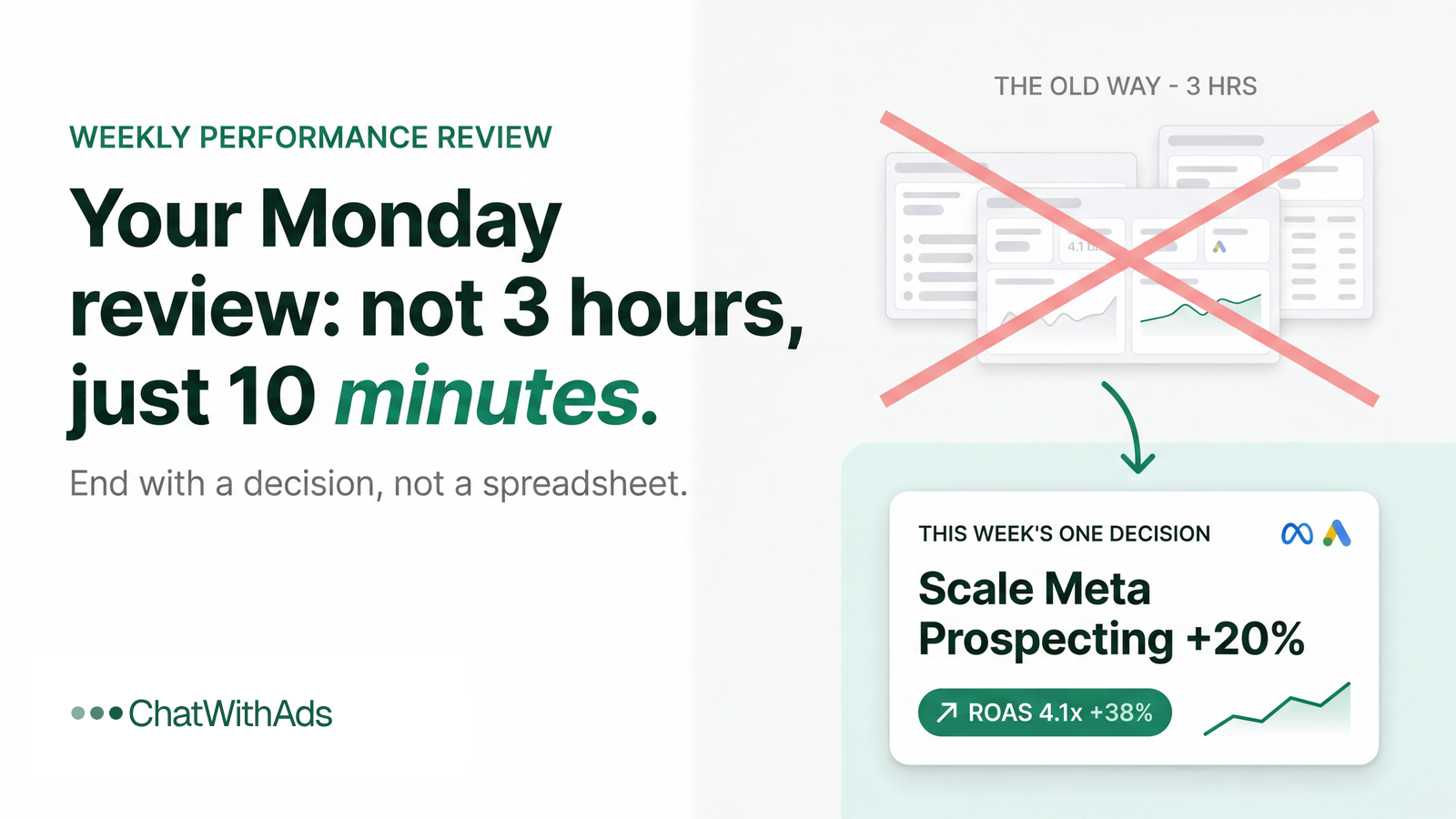
It's 9:04 on a Monday. You've got coffee, seventeen browser tabs, and a spreadsheet that hasn't been loaded yet. By the time you've pulled last week's numbers off every platform, lined them up, and figured out what actually changed, it's lunchtime. You haven't made a single decision. You've just assembled the data you needed to start thinking.
If that sounds familiar, you're not bad at your job. You've inherited a workflow that confuses gathering numbers with reviewing them.
The good news: the gathering part is exactly the part that should be automated away. A weekly review should leave you with decisions, not a data-entry hangover. Here's how to get there.
Why the 3-Hour Review Happens
The three-hour Monday isn't caused by complexity. It's caused by fragmentation.
Your work lives in different places. Meta is in one tab, Google is in another, maybe TikTok and Amazon are two more. Each platform reports differently, defines "conversion" differently, and credits the sale on its own timeline. So before you can compare anything, you become the thing that copies, pastes, and reconciles numbers that were never designed to sit next to each other.
Then comes the second tax: context-switching. Every time you jump dashboards, you lose the thread. You went into Google Ads to check a CPA spike and came out forty minutes later having reorganized a campaign you weren't even worried about. The work expands to fill the tabs you have open.
None of this is analysis. It's logistics. And logistics should not be eating the most strategic hour of your week.
What the Review Is Actually For
Strip it back. The point of a weekly review isn't to know what happened. It's to decide what to do next.
Three questions:
- What's working that I should give more money to?
- What's failing that I should cut or fix?
- What changed since last week that I need to understand?
That's it.
Everything else the chart-building, the tab-switching, the manual exports is overhead in service of those three answers. If a task on your Monday morning doesn't move you closer to an answer, it's a candidate for deletion or automation.
Hold onto that frame, because it's the filter for everything below. These reviews aren't won by whoever looks at the most data. They're won by whoever reaches a correct decision fastest and acts on it while the spend still matters.
The 10-Minute Framework
Here's the structure that replaces the slog. It works because it goes top-down from "is anything on fire?" to "what's the one thing I'll change this week?" instead of bottom-up through every line item.
Minutes 1–3: The Health Check
One glance at total spend, blended ROAS or CAC, and revenue versus last week.
You're not diagnosing yet. You're answering one question: is this a normal week or an abnormal one?
If everything's roughly in range, move fast. If a number is way off, that's your investigation for the day, and you skip the rest.
Minutes 4–7: The Movers
Look only at what changed meaningfully the campaigns and creatives that swung up or down beyond normal noise.
This is the heart of any real review: isolating signal from the week's natural variance. A 4% CPA wobble is noise. A 40% one is a story.
Spend your attention only on the stories.
Minutes 8–10: The One Decision
Pick the single highest-leverage action for the week.
Scale the winner, kill the loser, or move the budget toward the SKU or audience that's pulling its weight.
One decision you actually execute beats ten you note down and never touch.
Notice what's missing: there's no "build the report" step.
That's the whole trick. The framework assumes the data is already organized before you sit down.
The Metrics That Actually Earn a Place
Reviews bloat because people track everything, which means they prioritize nothing.
For a fast weekly read, keep the list short and decision-oriented:
- Spend — the input you control directly.
- ROAS or CAC — the efficiency verdict.
- Conversion volume — the absolute outcome (efficiency means little if volume collapsed).
- CTR and CPC — early warnings for creative fatigue and auction pressure.
- Week-over-week change on each — because the change is almost always more useful than the absolute number.
Anything beyond this belongs in a deeper monthly dive, not your Monday glance.
The weekly review is a smoke detector, not a forensic investigation.
Systematize It So It Survives a Busy Week
A framework only helps if it runs the same way every time, even when you're slammed.
You protect that consistency by separating the data layer from the thinking layer.
The data layer is the part to automate. A single view that pulls every channel into one place kills the copy-paste problem outright no more reconciling four platforms by hand. Set it up once, and the assembly work that used to cost you two hours costs you zero.
The more of the routine, repeatable work you systematize, the more your Monday attention goes to judgment instead of janitorial work.
The thinking layer is the part you keep for yourself.
No dashboard decides whether a 30% CPA rise means "pause it" or "it's a seasonal blip, hold." That's your call. It's why the role still needs a human.
Where ChatWithAds Fits
Even with a clean dashboard, there's a gap.
A dashboard shows you what the numbers are. It rarely tells you why they moved or what to do and closing that gap is usually where the leftover time goes.
That's the gap ChatWithAds is built for.
It's the chat that knows your ads. Instead of staring at a chart wondering why Saturday's CPA spiked, you ask, in plain language, and get a straight answer grounded in your actual account data:
- "Which campaigns drove the ROAS drop this week?"
- "What has changed on my top creativity since last Monday?"
- "Where am I overspending relative to results?"
It turns the middle of your review of the movers and the diagnosis from a manual hunt into a conversation.
You're not exporting CSVs or eyeballing trend lines to reverse-engineer a cause. You ask the question a smart analyst would ask, and you get the answer in seconds, so the only thing left to spend your time on is the decision.
And here's the part that matters: it reads every row of your account, and it changes nothing.
No campaigns paused behind your back, no budgets moved while you slept.
Think of it less as a tool that replaces you and more as a sharp analyst sitting next to you in the account, one that already reads everything so you don't have to.
The decision stays yours.
That's how three hours becomes ten minutes: not by caring less, but by deleting the work that was never worth your time.
Your New Monday, Start to Finish
Put it together and the morning looks like this:
- Open one consolidated view. Skim spend, efficiency, and revenue versus last week. (~2 minutes.)
- Ask what moved, and why. Read the answer instead of building it. (~5 minutes.)
- Commit to one decision and execute it before you close the tab. (~3 minutes.)
Ten minutes.
A clear read on the week.
One action taken.
And a morning that's still yours for the work that actually involves testing new creative, planning the next offer, thinking two weeks ahead instead of cleaning up last week.
The Real Takeaway
The length of your review was never a sign of how seriously you take performance.
If anything, the three-hour version hurts performance, because it burns your sharpest hour on assembly and leaves the decisions for when you're already tired.
Treat data-gathering as overhead to automate.
Protect your judgment as the thing only you can do.
Do that, and you'll wonder how Monday ever ate your whole morning.
Next week, give yourself a timer.
Ten minutes.
See how much of the old three hours you actually miss.
Get the next one in your inbox
Marketing-analytics deep dives like this one, straight to your inbox. No spam, unsubscribe anytime.